Monday, February 1, 2010

Education and Urban Poverty


Nelson Mandela once said, “Education is the most powerful weapon which you can use to change the world.” Education influences ones behaviors, attitudes and most importantly ones future. In my blog post, I chose to discuss access to education for children in the metro Manila as well as the relocated communities. Do the children have less access to schools now they have been relocated; similar to how the adults in the communities have less access to work since being relocated? Education standards and requirements are universal throughout the Philippines; both urban and rural children need to meet the same standards, whether they are given the resources to do so is up for question. There is clearly a causal relationship between education and urban poverty primarily due to lack of understanding and awareness of their environment as well as their means of improving their way of life.

While at the communities we were able to visit the pre-schools that have been opened within the blocks to help children get a head start on their education. I believe this was an excellent way to show the movement towards sustainability within the community. It speaks to the foundation that is being set for these children; that education is a critical priority in their lives. I was able to observe the beginning of a pre-school session; they began with a prayer, national anthem and then went in identifying letters in the alphabet. The children were all excited, all willing and eager to answer the instructors’ questions; even if they were unsure they still made an attempt. The instructors were supportive and encouraged the children to try again if they did not get it on the first time.

It was also my observation, while walking through the community as well as traveling through metro Manila, there were groups of children and teenagers on the streets, sitting outside of houses, or hanging out in community venues. I kept thinking, “Why are these kids not in school?” It was during the week as well as during typical school hours. In one day, it would not be difficult to spot hundreds of kids wandering the streets while traveling through Manila. This begged the question; do these kids have basic access to education? One would assume living in metro Manila; children would have access through public transportation or simply walking to school. However, if we were to look at access to education in the rural community, how to these children get to and from school?

Some would argue that the problem with access to education in the Philippines is due to the continuing social divide in the country. The Undersecretary of education publically points out that education in the Philippines has been on a continuous decline for the last 25 years, largely because of the social divide. An article written by Ronald Meinardus of the Friedman Naumann Foundation for Liberty points out that there are two possibly solutions; increase the resources for education or institute a systematic population policy. http://www.fnf.org.ph/liberalopinion/crisis-public-education-philippines.htm

Both solutions make sense and should be considered. I believe that lack of resources has already been approached but there is considerable difficulty trying to fix that at this point due to the economy in the Philippines as well as around the world. Over population is something needs to be addressed by educating and creating awareness of its effects. Being a predominately Catholic country, population control would have to be explained and justified very clearly to the people of the Philippines.
Although the solution is not clear, it is institutions like Adamson University and the community leaders of Northville and Southville that are making a change. Each day they continue to educate the adults as well as the children on the importance of education and knowledge, the closer they get to alleviating urban poverty.

by Melinda Whitemarsh

Stand With The Poor


do not pity the poor.

You do them no favors, your help is limited. Even with the most altruistic motives, when you move on, you leave them behind.

do not pity the poor.

You extend help out of guilt, appeasing an internal need. You extend help as far as you think you can, without asking the poor what they need.

do no pity the poor.

Stand with the poor!

Partner with them and listen to their voices. Hear their needs and dreams. Look at the skills you have that can help them. Teach them, and learn from them.

Stand with the poor!

Empower the poor and watch them grow. See new leaders and innovators wherever you turn. Realize how you change. Realize how society changes.

Stand with the poor!

The foundation of human dignity binds people together. – Father Nonong


************************************************************
As I walked through Southville 1, I thought how vibrant this place is. How joyful and energetic the community members are. There is a unique energy flowing here. I needed to know why the members felt this way, why the community was buzzing.
My answer started before I even stepped foot in Southville 1. From day one, Father Nonong and the Adamson staff volunteers emphasize how human dignity is the foundation for VCSR and for lasting change. Their perspective is partnership, not pity when it comes to reaching out to the poor. By being with and listening to the community members and hearing their needs, Father Nonong and Adamson are able to assess what Southville residents need.

The residents in turn want to partner. They do not ask for food and handouts, but skills and leadership training. Community members have learned that the answer to their needs is not more money, but to see what assets Southville 1 already has. They need Adamson staff volunteers to help them realize their resources and know how to use them.

The mutual dedication to holistic change is the backbone to this program. It is not the Adamson staff reaching down to help pull up the poor, but rather it is them walking alongside the members of the community. The members of the community in turn invite the Adamson staff volunteers into their lives, and being vulnerable; allow the staff to teach new skills and disciplines. Through the VCSR program, mothers become managers of a family. They save and set goals. They gain confidence to become part of a community. Soon networks form and economic opportunities arise with small business run out of the home in their neighborhood. As the community grows, they share life with the Adamson staff volunteers, and impact them deeply. The staff’s dedication shows how much this community means to them.
Real life learning and experience here is so much stronger than in just a classroom. The Adamson staff are then armed with experiences to take back to their weekly classrooms where eager students await them. Here too the staff can advocate for the poor, sharing their passion with new students so that they too see how human dignity binds us all. Then they too can stand with the poor.

by Jamelyn Lederhouse

Unheard Voices and Prevalent Corruption: An Insight on Urban Poverty in Metro Manila


The same man and architect, Daniel Burnham, designed the cities of Chicago, Illinois and Manila, Philippines, yet the composition of both metropolitan areas share few similarities. Unlike the beautiful aesthetics and scenery of Chicago’s Lake Shore Drive, garbage and children wearing no clothes made up the panorama on the side of the street next to the water in Manila. One of the first images I saw while in the Philippines will be one etched in my mind forever. I took the picture shown above the morning after I arrived in Manila when my group was on our way to lunch. The photo is of where the Pacific Ocean meets the coast of the city of Manila, Philippines; however, the picture reveals much more than the blue ocean water. Along the coastal wall, mounds of trash and waste sit in the water as a result of people dumping their garbage over the side and lack of government action towards the problem.

Although the people of Manila and the damage from the recent typhoons caused much of the compost to accumulate, this photo also proves the inadequate response by the Philippine government at national and local levels. A key contributing factor to the prevalent urban poverty in Manila is corruption within its government entities. Despite the current efforts of President Macapagal-Arroyo, the concept of good governance is too seldom depicted in the Philippines. Within the past two years, watchdog agencies such as the Asian Development Bank and World Bank published documents regarding the pillar of good governance at http://www.adb.org/Documents/Policies/Anticorruption-Integrity/Policies-Strategies.pdf and http://info.worldbank.org/governance/wgi/sc_chart.asp . Both organizations explicitly illustrate their policies, governance indicators, and charts concerning their anti-corruption policies. While the ADB emphasizes their strategies to end corruption, the WB focuses on governance indicators in the Philippines such as: voice and accountability; political stability; government effectiveness; regulatory quality; rule of law; and, control of corruption.

One of the main reasons corruption in the Philippine government perpetually continues is due to the people’s lack of involvement with national and local government and the governmental deficiency of engagement with its people. Among the urban poor, voices go too frequently unheard. While in the Southville housing projects of Cabuyao, we had the opportunity to interview some of the female block leaders partaking in the Vincentian Center for Social Responsibility program. When asked if the government became more involved after the implementation of VCSR programs, the women responded no. The block leaders said the garbage and water systems were brought up during the Second Congress, but they took no action. The women stated sometimes it takes up to four months for garbage collection, and there is no place large enough to amass it all.

Based on the government negligence in the remote Southville housing projects, the vast amount of waste remaining in the water in metropolitan Manila is not staggering. What was not shown in the picture were the dozens of naked children swimming in the polluted water, or the urban poor living on the street on the other side. Needless to say, both situations call for immediate government need and intervention, and will only worsen as good governance remains absent and corruption perseveres.

by Meredith A. Koch

Sunday, January 31, 2010

Change they can believe in...


We hear so much about sustainability in discussions of poverty reduction – and with good reason. Money, supplies, programs and even facilities coming from the outside are only temporary solutions and once the providing organization exhausts its funds and exits a community, life typically returns as usual. While it might be easy to put blame on an organization for leaving a community, it cannot be an end goal that an organization remains to prop up a community as a long-term solution. So how does an organization assist a community to achieve sustainable change?

While there is no one cure-all prescription, the Vincentian Center for Social Responsibility (VCSR) program’s innovative approach combines resources for increasing income and financial assets with resources to develop a community’s human potential. VCSR brings the residents of Southville the important concept of collaboration and organization. Through developing resident’s self-esteem, teaching them how to express their thoughts and feelings, and bringing them together each week, VCSR helps community members realize that their voices together can make them much more powerful than they can be alone. Community members spoke about their new sense of community that did not exist when they lived along the railroad. They described how VCSR had brought many of them out the isolation of their homes to interact with their fellow community members. They are able to speak with confidence and passion about the plight of their community. They are knowledgeable about the problems they face and they have ideas about how to overcome them. While there is still much work to do, if VCSR left their community today, I don’t believe life would return as usual. I believe these residents would be able to take over the process for themselves. And ultimately this is the end goal that can lead to sustainable change – empowerment.

It is also important to recognize who is being empowered in the community – and it is overwhelmingly women. Because the vast majority of the participants are women, it is the women who are gaining self-esteem and life skills. It is the women who are earning additional income for their families, saving money and beginning to become the decision makers in their homes. It is the women who are organizing themselves, and the women that are the rising leaders in the community. While women’s empowerment is a goal within itself, I believe there is also a correlation to poverty eradication.

As VCSR works to extend its reach to the greater community, I believe it needs to start handing over pieces of the responsibility to Southville community members. They are ready, willing and it would be an opportunity to build further leadership skills. Participants who’ve completed the first two years of the program should serve as facilitators for the new batches. Community members should have a voice in determining what the next livelihood program will be. And ultimately, they should lead the process for creating change in their community.

Saturday, January 30, 2010

Changing Social Constructions in the Philippines


As I walk away from the Manila Study Abraod Program and write this impact analysis, many ideas, pharases, words, and images come to my mind. The Manila Study Abroad Progras has given me the unique opportunity to rebuild notions about strategies and methodologies for poverty alleviation. I coud spend hours discussing how the Vincentian Center for Social Responsibility (VCSR) establishes a strong foundation in the community throughout the values formation program, or how they increase civic engagement, rights awareness, and good governance through participation, empowerement, and servant-leadership. Nevertheless, I would like to discuss how VCSR shifts the social construction of the Southville community, positioning it in a different way in front of public officials, the media, nongovernmental organizations, academia, and the community itself.

According to Schneider and Ingram in the Social Construction of Target Populations (1993), the social construction of a target population refers to the recognition of the shared characteristics that distinguis a target populations as a socailly menaningful, and the atribution of specific, valence-oriented values, symbols, and images to the characteristics.

I believe that this shift in the stereotypes of the relocated communities quitely influences policy makers to apply an asset-based approach in their anaylis and decision making process. This positive picture of the community sets a different agenda, behavior, and methodology among the various stakeholders who will look at the Southville community in a positive and strong category, rather than in a negative and weak group.
The idea began when Father Nonong Fajardo, Director of the Adamson University Integrated Community Services (ICES), shared in his opening speech that their most important learning when they first approached the community was that "people living in poverty were already organized, highly participatory, and entrepreneurs," shifting VCSR paradigm and approach for the implementation of the program. VCSR, staff and volunteers, realized that contributions would come from both sides VCSR and the community. At the same time, it motivated the community to shift the way they engaged in the initiative and looked at themselves as contributors. The community moved from merely expecting financial support to see, and reach, their own potential, individually and collectively, building a strategy to improve the community as a whole.

The most powerful moment I experienced was when VCSR facilitators led an activity where participants had to write down their goals. This activity caused commotion among the participants who were fearful because they felt they did not have the menas to achieve their dreams. The facilitators masterly handled the situation, explaining that only a small percent of the world population know what they want, write it down, and work towards it. They also added that failing was an opportunity for grow and it was responsibility of the entire community to support each other for their individual and collective goals. This moment gave participants the oppotunity to look at themselves as part of a selective and privilege group.
Finally, representatives of the National Housing Authority (NHA) recognized that VCSR influenced urban planning policies. Therefore, they incorporated a participatory approach in their planning. This policy reallocates resources differently to fill the gaps and needs identified by the commiunity and not by public officials alone.

This initiative is reaching its goal by constructing a positive image of the community and building an asset-based apporach across stakeholders, providing the community the oppotunity to influence policies, methodologies and therefore reducing inequality in the Philippines.


Friday, January 29, 2010

The Urban Poor

In this posting, I plan to address how research helps the urban poor. We often think of the academic world as operating in a vacuum, apart from reality. The experience of going to Manila and Southville, however, has revealed that academic endeavors can and should be fully integrated with human experience. Even if they may never have the chance to review the results for themselves, the poor benefit from social action research in three primary ways. First, researchers provide exposure to conditions that the poor live in. Second, researchers legitimize the efforts of the poor to change their reality. Thirdly, researchers provide tools for people to be able to enhance their living conditions. I saw all three of these things at work in Southville through the presence of Adamson University. The poor were not being used as social test subjects. Rather, the poor were participants in the work to help them transform their community.

Researchers provide exposure and voice to the harsh realities of the urban poor. Even though the urban poor are in people’s midst in great cities like Manila, it is still easy to overlook them. When governments make policy or funding decisions, they too often forget about the under-represented poor. Researchers, however, force the government and other authorities to take notice. It was clear that the reason why the Philippine housing authority officials were so involved in the railroad relocation project was because of the presence of VCSR and Adamson University. Through the work of researchers, there was suddenly an abundance of household information on the people living along the railway, and this information helped with planning to ensure the safe and peaceful relocation of these people to Southville. Those people who are easily overlooked, are given a voice through the work of social researchers. This exposure and advocacy has kept the government interested and involved in Southville.

The poor are endowed with talents, drive, innovation, and political will. The intangible assets of under-resourced communities receive legitimization through the presence of researchers. The poor are gifted, and researchers are able to provide academic legitimacy to their efforts to transform their reality. In Southville, VCSR recognized the inherent entrepreneurial nature of the people as well as their deep-seeded family values. Researchers help the poor identify these strengths so that they can be leveraged for their good.

Finally, researchers offer tools for development which build upon the gifts of the people. The SV-SUDS program is a quintessential example of this. Researchers saw that the people had entrepreneurial aptitude and motivation, so they introduced a tool which would help the poor take advantage of this talent. I believe that values formation was another important tool that researchers were able to introduce into the community. Recognizing the strong family and faith structure of the community, VSCR conducts values formation to enable the community to build upon these strengths. By solidifying family and community ties through values formation, the community is better prepared to unify themselves and work toward common goals which will result in improved conditions for their community. I think the presence of a community congress, which convenes to discuss local issues, is an example of how the tool of community-building and values formation has come to fruition.

These examples prove that when conducting urban planning, NGOs and Governments should network with academic researchers to help guide policy and funding decisions. The relatively smooth transition of thousands of people from the railways of Manila to suburban settlements is credited to the presence of an academic community. By providing exposure to their conditions, legitimization of their talents, and tools for their development, academic researchers in the Philippines have demonstrated that social research must extend beyond the classroom setting to find a meaningful application in the everyday reality of the poor.

References

See link to the “Great Cities Institute,” Housed through the University of Illinois at Chicago.
http://www.uic.edu/cuppa/gci/research/index.shtml

The picture at the top was taken during our first trip to Southville. I believe this photo simultaneously represents all the things that I’ve just spoken about above. The poor are a beautiful, gifted people, with strength and motivation to enhance their future. They are open to the work of the academic community (as evidenced by the welcome sign). This child represents the bright future of this community.

I would be remiss not to publically mention that I believe deeply in the mission of VCSR and what the academic community is offering the community of Southville. After my visit to this community, I have become utterly convinced that researchers can help people by providing opportunities for economic and social development.

The fact that all efforts are community-led is the true ‘selling point’ of the VCSR program. And I believe that all future researchers should continue to not only respect the community, but take direction from the community as well. This way, people are given the opportunity to create change in their lives, rather than have an outsider fix it for them. This is the core philosophy that I saw in VCSR’s process. Those community members who were already active through VCSR had a real sense of what they were contributing and VCSR was assisting this ‘awakening’ in the people. Ongoing research can facilitate the ongoing ‘awakening’ of the people, in that they will become more of aware of their power and their ability to transform their community utilizing their own assets. For example, the women who were serving as day care leaders had a keen sense that they themselves (not outsiders) were educating and forming their children for the future.

In the midst of some immense economic challenges, these people see cause for hope, and the academic community has helped bring this hope to them. All around Southville we saw smiles and optimism. One woman that I spoke with, told me that she earns a few dollars a day through the SUDS program, but emphasized to me that she feels deeply blessed.

Finally, I saw people who formerly didn’t know their neighbors, now banding together to transform their community. The academic community has given people the forum to create these important bonds and sense of community. Fortunately, this sense of community will persist long after VCSR has withdrawn from the community.

It was an honor to journey with this group of people and to take part in such an effective model of development. Thank you for your work with the urban poor!

Wednesday, January 13, 2010

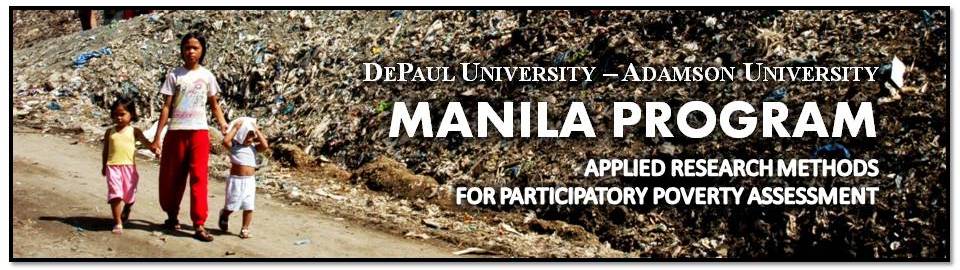
The Manila Program


The School of Public Service Manila-Philippines study abroad program (Manila Program) is the result of an ongoing institutional collaborative effort between DePaul University and Adamson University, the third largest Vincentian higher education institution in the world. In line with the Vincentian values of service learning, social responsibility and poverty reduction, the Manila Program is a unique learning experience for students interested in collaborative and applied research for poverty reduction, community development and systemic change. The program focuses on experiential learning and professional collaborations through adapted methods in Participatory Action Research (PAR), Participatory Poverty Assessments (PPA), and Appreciative Inquiry (AI) adapted to Vincentian urban poverty reduction. Given the expertise and interests of the graduate students in public service at DePaul University, the program offers opportunities to tackle poverty through social impact analysis of micro-savings and community-social entrepreneurship programs organized by the Vincentian Center for Social Responsibility (VCSR). The Manila Program reflects DePaul University’s commitment to educate students about international problems and to become ethically and socially responsible global leaders, as expressed in the Strategic Plan Vision Twenty12. In addition, the collaboration between our Vincentian universities contributes to DePaul University’s commitment to further institutionalize its Vincentian and Catholic identity by developing academic partnerships.